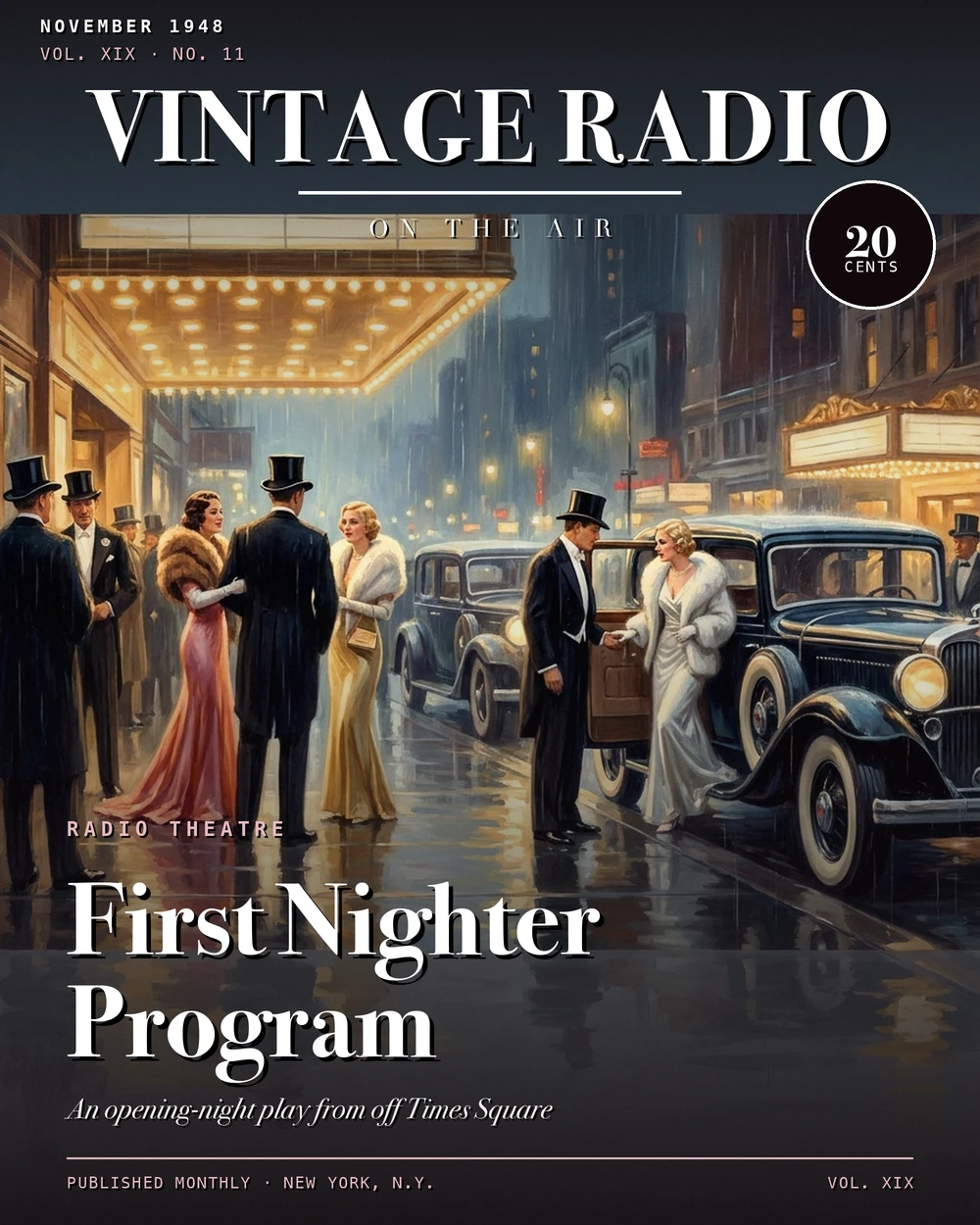
First Nighter Program
The Little Theater Off Times Square
Before the curtain goes up, you hear it: taxi horns, the shuffle of a crowded sidewalk, a police whistle cutting through the noise. Then a familiar voice settles into the third row center and whispers an introduction, and suddenly you're not at home anymore — you're at the theater. That was the trick at the heart of the First Nighter Program, and it worked well enough to draw eight to ten million weekly listeners by 1937, outranking shows hosted by Fred Allen, Eddie Cantor, Burns and Allen, and Rudy Vallee.
The show debuted on November 27, 1930, on NBC Blue Radio. Its premise was a theatrical conceit: a fictional venue called "the Little Theater Off Times Square," where the host character, Mr. First Nighter, took his seat each week to watch a new original play. The Broadway connection wasn't musical — there were no show tunes or performer interviews. The connection was atmosphere. The show recreated the experience of a night at the theater using sound design alone: the crowd, the usher's announcement at commercial breaks, the buzzer, the curtain call that signaled the play resuming. Performed before a live studio audience, with the lead actors in formal attire — the leading lady in a gown, the male lead in evening clothes and top hat — the production committed fully to the illusion.
A 1939 newspaper article credited the First Nighter Program as "the first show to present complete and separate original plays each week." That claim held up. Each episode was a self-contained original romantic comedy written for radio, not adapted from another source. The show's run stretched from 1930 to September 27, 1953, encompassing over 750 first-run episodes.
How It Was Made
The show originated from Chicago before later broadcasts came out of Hollywood. It was created and produced by Charles P. Hughes, who also played Mr. First Nighter himself from 1930 to 1935. Joseph T. Ainley handled production and direction, with announcers Larry Keating and Vincent Pelletier working the broadcasts. Music — incidental, supporting the dramatic action rather than leading it — came from the Famous First Nighter Orchestra, directed by Eric Sagerquist from 1930 to 1944, then Caesar Petrillo through 1946, and Frank Worth for the final run from 1947 to 1953.
The primary scriptwriter was I. Willard Crull, who wrote under the pseudonym Anthony Wayne and contributed over 100 original radio plays to the series. Crull had an unusual dual role: he was also vice-president and treasurer of the Campana Sales Corporation, the show's principal sponsor. That kind of overlap between creative and commercial interests was not unheard of in 1930s radio, but Crull's output — more than a hundred original plays — was by any measure a substantial body of work.
The show's most requested episode was the annual Christmas play "Little Town of Bethlehem," first performed in 1937 and repeated every year thereafter at audience request. Among the surviving episode titles in the catalog: "Love is Stranger Than Fiction," "Old Lady Shakespeare," "The Heart That Has Truly Loved," and "Love and Gazozza."
The Cast Over the Years
The show's romantic lead pairings changed several times across its run. Don Ameche and June Meredith anchored the early years from 1930 to 1936, with Betty Lou Gerson stepping in alongside Ameche for part of that stretch in 1935 and 1936. The most durable pairing came next: Les Tremayne and Barbara Luddy carried the show from 1936 to 1943. Luddy then stayed on when Olan Soule took the male lead from 1943 onward.
Ameche's time on the show helped establish him as a recognizable name in the early 1930s, a profile that led directly to his move into Hollywood films under 20th Century Fox producer Darryl Zanuck. The host role of Mr. First Nighter passed through several hands after Hughes: Macdonald Carey, Bret Morrison, Marvin Miller, Don Briggs, and Rye Billsbury, who later worked under the name Michael Rye.
The Sponsor and the Network Moves
The First Nighter Program's network history is complicated enough to suggest how much work it took to keep a radio anthology alive across two decades. It started on NBC Blue, moved to NBC proper in late 1933, jumped to CBS in early 1937, returned to NBC the following January, was back at CBS by September 1938, spent two years on Mutual starting in October 1942, then returned to CBS for the remainder of its first-run life, which ended in October 1949. A final run of repeats aired on NBC from April 1952 through September 27, 1953, for a different sponsor.
Throughout most of that history, the show's primary backer was the Campana Company, a Batavia, Illinois-based manufacturer of cosmetics. The program served as the national launching vehicle for Campana's Italian Balm hand lotion, which became the best-selling hand lotion in the United States by World War II. The pairing of a romance-centered anthology drama with a hand lotion sponsor made obvious sense, and the association held for most of the show's run. It was a long-term commercial relationship that helped stabilize a series that might otherwise have been cancelled during one of its network transitions.
What Survived
Of more than 750 first-run episodes, fewer than 40 are known to survive. The catalog here contains 20, with the earliest dated March 25, 1941, and the latest September 1, 1953. That's a narrow window into a long run — most of what the show produced is gone. What remains is enough to hear how the theatrical framing worked in practice: the sound design that opened each episode, the style of the romantic comedy writing, the orchestra filling the spaces between scenes.
The loss isn't unusual for radio of that era; most programs from the 1930s and early 1940s survive only in fragments if at all. The First Nighter Program ran for more than twenty years, outlasted multiple network arrangements and sponsor relationships, and held a weekly audience of millions at its peak. The surviving episodes are what's left of something considerably larger.